Natural Energy. Nothing Else. That principle gets tested harder over 50, 100 or 160 kilometres on foot than almost anywhere else. In an ultra marathon, fuelling isn't a side detail. It decides whether you finish strong, shuffle home or stop at an aid station with nothing left. This guide covers race week to recovery, built on the International Society of Sports Nutrition (ISSN) position stand on ultra-marathon nutrition [1]. For more on training and racing, head to our Training Hub.
Running is in TRIBE's DNA. Our co-founders ran 1,000 miles from Ukraine to Croatia in 2013, raising money to set up the UK's first shelter for trafficked children and laying the foundations of the TRIBE Freedom Foundation.
Why Fuelling Decides Ultras
An ultra runs on stored glycogen, fat, and whatever you manage to eat and drink along the way. Glycogen is limited, and fat can't be turned into energy fast enough to cover everything on its own.
The ISSN frames the challenge simply: start fuelling early and keep going, taking in around 150-400 kcal an hour, mostly from carbohydrate, for as long as the race lasts [1]. It also flags gastrointestinal problems as a major issue in ultra racing [1]. You need to eat, and the longer you run, the less your stomach wants you to. The good news: most of it is trainable. And if you're still building towards your first ultra, our guide to the health benefits of running covers why the miles are worth it.
Everyday Fuelling in Training
The ISSN recommends a moderate-to-high carbohydrate diet for ultra runners in training, around 60% of energy intake or 5-8g per kg of bodyweight a day, to limit the effects of repeated glycogen depletion [1]. For a 70kg runner, that's roughly 350-560g a day, scaled up on big days and down on rest days. Protein intakes of around 1.6g per kg a day help maintain muscle and support recovery, with up to 2.5g per kg warranted in the most demanding blocks [1]. The ISSN favours a varied, food-first approach [1]: oats, rice, potatoes, bread, pasta, beans, lentils, fruit and vegetables should do most of the work.
Race Week and Carb Loading
How Much Carbohydrate Before an Ultra?
For events lasting longer than 90 minutes, American College of Sports Medicine guidance describes carbohydrate loading as 10-12g per kg of bodyweight a day for the 36-48 hours before [2]. For a 70kg runner, that's 700-840g a day, which is a lot of food. Many ultra runners, racing at lower intensities than marathoners, find a moderate version works: moving towards the top of their usual 5-8g per kg range [1] and beyond as training drops in the taper. Whichever you choose, rehearse it before a long training run first.
Making Carb Loading Work
Carb loading doesn't mean eating twice as much of everything. Make carbohydrate a bigger share of each plate and ease back slightly on fat and fibre, which fill you up without adding much fuel. White rice, pasta, bagels, peeled potatoes, bananas and fruit juice make high targets easier. Storing glycogen also stores water, so a small rise on the scales is normal.
Taper Weeks, Travel and the Afternoon Before
Tapering brings less running, more nervous energy and long journeys to the start, and it's easy to fall back on vending machine snacks and coffee. TRIBE Protein + Focus is the bar we pack for those days: 10g of plant protein, eight B vitamins and 56.25mg of magnesium, with zero caffeine, so there's nothing in it to keep you awake the night before a race. Magnesium and vitamin B6 contribute to normal energy-yielding metabolism and the reduction of tiredness and fatigue, and magnesium also contributes to normal muscle function and electrolyte balance [3].

One practical note. The Choc Brownie and Peanut Butter flavours carry 7-8g of fibre per bar, which is great for everyday eating but more than you want in the final hours before the start. Enjoy them in the taper and the afternoon before, and keep race morning low in fibre.
The Pre-Race Breakfast
Overnight, your liver glycogen drops. Breakfast tops it back up. Sports nutrition guidance suggests 1-4g of carbohydrate per kg of bodyweight, eaten 1-4 hours before exercise lasting longer than an hour [2], with larger amounts needing a longer gap. Most ultra runners land in the middle: a solid breakfast two to three hours before the start, then small sips of fluid until the off.
The best race breakfast is one you've eaten before every long run for weeks. Keep it high in carbohydrate and low in fibre, fat and spice: white toast or bagels with jam or honey, porridge made a little looser than usual, rice pudding, a banana or fruit juice. If nerves kill your appetite, a smaller breakfast plus a snack in the start pen beats nothing.
Fuelling During the Race
Hourly Carbohydrate Targets
The ISSN recommends 30-50g of carbohydrate an hour during ultra racing [1]. General sports nutrition guidance allows up to 90g an hour for events longer than two and a half to three hours, using mixed carbohydrate sources [2], but 30-50g an hour is a realistic, well-supported target at ultra pace. Start in the first hour, not when you start to feel flat.
Real Food vs Gels
Gels are compact and easy to measure. They also get very sweet, very quickly, and plenty of runners find a sixth sachet harder than the next climb. At ultra pace, real food becomes a genuine option, and for many the preferred one. The best answer for most is a mix: real food as the backbone, gels or sports drink as a quick top-up.

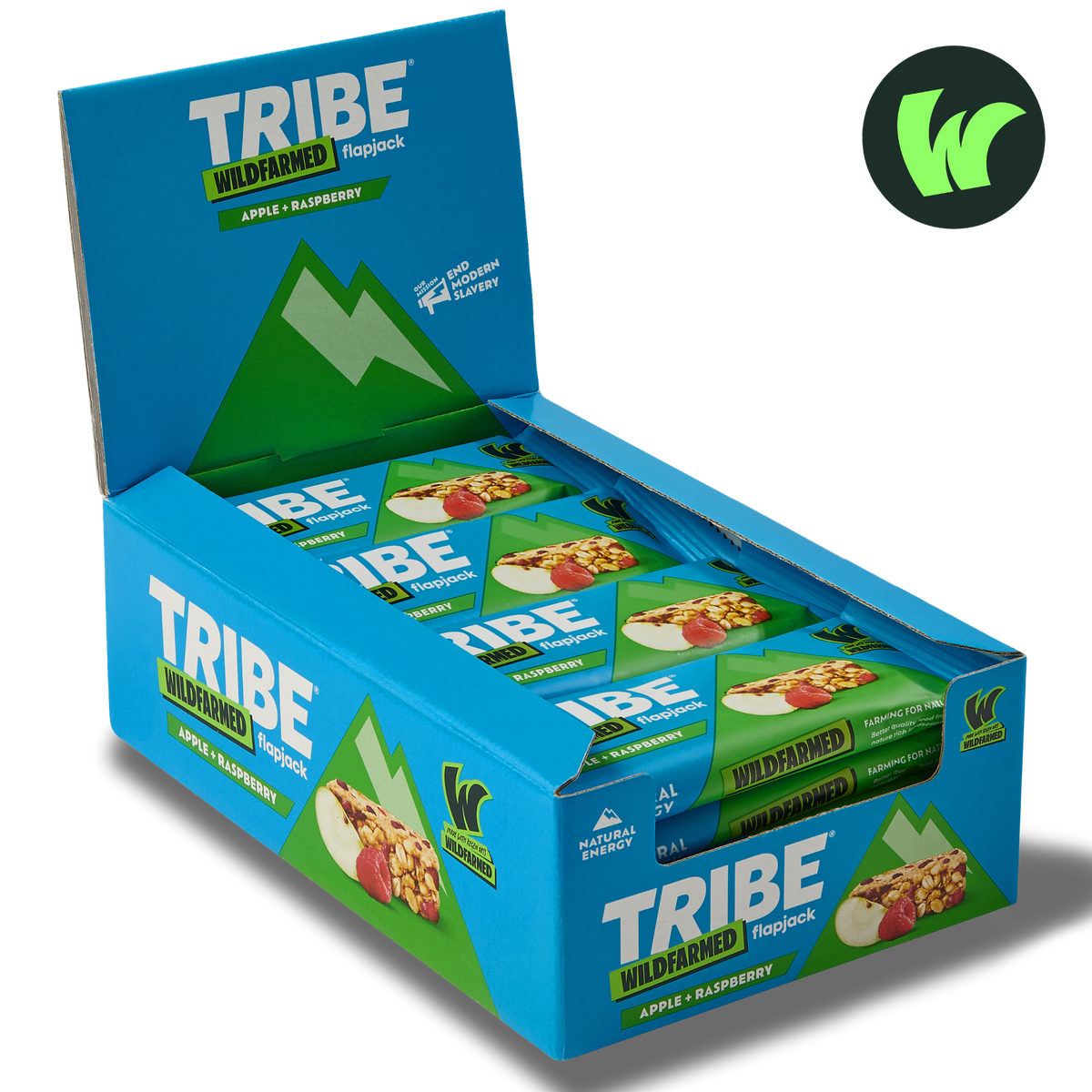
That's why we made TRIBE x Wildfarmed Flapjacks. Each 50g bar gives around 30g of natural carbohydrate from regeneratively farmed Wildfarmed oats, so one bar an hour sits inside the 30-50g target [1], with room to add sports drink or fruit to reach the top of the range. They're soft and chewy, low in fibre (2.4-2.9g per bar), and come in Apple & Raspberry, Blueberry & Almond Butter, Toffee Pecan & Raisin and Choc Hazelnut. They're vegan but contain gluten, so they're not one for coeliac runners.
Little and Often
Your gut handles small, regular amounts far better than a big feed every couple of hours. Break your hourly target into chunks every 20 minutes: a third of a flapjack, a few mouthfuls of sports drink, a couple of boiled potatoes at an aid station. Cut bars into pieces before the race, and set a repeating alarm on your watch if you tend to forget.
Fuelling by Race Length
50K (roughly 4-8 hours for most runners). The closest to marathon fuelling. Hit 30-50g an hour from the start, mostly from what you carry. The 43km Box Hill Ultra in the Surrey Hills sits here, with climbs that make regular fuelling a smart habit.
100K and 100 miles (roughly 10-36 hours). Flavour fatigue arrives and savoury food starts to matter. Lean more on aid-station real food, vary tastes and textures, and treat eating as a job every 20-30 minutes regardless of how you feel. Have a backup for when your main fuel stops going down.
Multi-day events. On a stage event like the five-day, 200km TRIBE Run for Love Dolomites, each day's recovery is the next day's fuelling. More on that below.
Night Sections and Appetite Fatigue
Long races often run through the night, when appetite tends to fade. Many runners find sweet food hard to face after several hours, while warm, salty food such as soup, noodles, broth or potatoes becomes surprisingly appealing. Pack savoury options in your drop bag and keep eating small amounts.
Aid-Station Strategy
Find out what each aid station stocks and practise with the same foods in training. Arrive with a plan: refill bottles first, grab food to eat as you walk out, and don't linger. A test bite of something new is fine; a full plate is a gamble.
Hydration, Electrolytes and the Risk of Drinking Too Much
How Much to Drink
The ISSN suggests around 450-750mL of fluid an hour during ultra racing, roughly 150-250mL every 20 minutes, with needs higher in hot or humid conditions [1]. Treat that as a guide range, not a quota.
Sodium and Electrolytes
Sodium is the main electrolyte lost in sweat. The ISSN notes ultra runners may need sodium in concentrations above what most commercial sports drinks provide, in some cases above 575mg per litre [1]. Salty foods, electrolyte tablets and broth can all help. For more on another key mineral, see What Magnesium Actually Does for Your Energy and Focus.
The Risk of Overdrinking: Exercise-Associated Hyponatraemia
Drinking too little is a problem. Drinking too much can be dangerous. Exercise-associated hyponatraemia (EAH) is when blood sodium falls below 135mmol/L during or up to 24 hours after exercise, and the international consensus statement identifies drinking more than your body loses as the main cause [4]. Early symptoms can include light-headedness, nausea and puffiness; severe cases can bring headache, vomiting, confusion and seizures, and it can be fatal [4].
Slower runners out on course for many hours are among those at greater risk, weighing more at the finish than the start is a sign you've overdrunk, and extra sodium hasn't been shown to prevent EAH if you're overdrinking [4]. The consensus recommends thirst as your guide [4]. In practice: drink to a plan and to thirst within the ISSN range [1], and don't force down fluid you don't want. If you're sloshing, bloated or constantly needing to wee, ease off.
Training the Gut
Gut problems are one of the most common ways ultras go wrong [1], but your gut is adaptable. Asker Jeukendrup's review on training the gut describes how regularly taking in carbohydrate during training may help the stomach empty faster, increase how much carbohydrate the intestine can absorb and reduce discomfort during exercise [5]. Some of the absorption evidence comes from animal studies and human research is still developing [5], but the message matches the ISSN, which supports progressive gut training [1].
- Practise your exact race fuel on every long run, not just the last one.
- Start around 30g of carbohydrate an hour and build gradually over weeks.
- Rehearse at race pace, in race kit, with the fluids and aid-station foods you'll use.
If gut symptoms persist despite practice, the ISSN notes a short-term low-FODMAP diet before racing may help some runners [1]. That's best done with a registered dietitian.
Caffeine and Ultra Running
Caffeine works for a lot of runners. The ISSN position stand notes it may benefit some ultra runners [1], and plenty use it tactically late in a race or through the night. If you've tested it and it works for you, it's a legitimate tool.
It isn't for everyone. Some runners find it upsets their gut, makes them jittery or wrecks their sleep before a race. That's why TRIBE's bars are deliberately caffeine-free: your everyday fuel, taper snacks and race food don't need to carry a stimulant, which leaves you in control of if, when and how much caffeine you use on race day. We explain our thinking in Why No Caffeine Is the Better Choice for Sustained Energy.
Recovery: The First Hours and the Week After
The First Few Hours
Crossing the line isn't the end of the fuelling plan. Rehydrate sensibly and start on carbohydrate and protein as soon as your stomach allows. Sports nutrition guidance suggests around 0.3g of protein per kg of bodyweight after key sessions, repeated every 3-5 hours across meals [2]. For a 70kg runner, that's roughly 20g.

A shake is often the easiest way in when solid food doesn't appeal. TRIBE Protein Superblend gives 20g of pea and rice protein per serving alongside 13 vitamins and minerals, and it's caffeine-free. Blend it with a banana and milk or oat milk to add carbohydrate, then follow with a proper meal.
Multi-Day Events
With less than eight hours between demanding efforts, sports nutrition guidance suggests 1-1.2g of carbohydrate per kg of bodyweight an hour for the first four hours to speed up refuelling [2].
The Week After
Recovery from an ultra takes days, not hours. Keep protein at around 1.6g per kg a day or more [1], keep carbohydrate at a sensible level rather than cutting it straight away, eat plenty of fruit and vegetables and sleep more than feels necessary.
A Simple Sample Fuelling Plan
A starting framework for a 70kg runner. Adjust to your bodyweight and test everything in training.

- Race week: carbohydrate at the top of your usual 5-8g per kg range [1], towards a full carb load if you've tested it [2]. Protein + Focus for taper and travel snacks.
- Race morning: a familiar, low-fibre breakfast of 1-4g carbohydrate per kg, 1-4 hours before the start [2].
- Every 20 minutes: a third of a TRIBE x Wildfarmed Flapjack (about 10g carbohydrate) and 150-250mL of fluid, guided by thirst [1, 4]. That's roughly 30g of carbohydrate and 450-750mL of fluid an hour [1].
- Every hour: top up towards 40-50g of carbohydrate with sports drink, fruit or aid-station food, plus salty food or electrolytes in the heat [1].
- Night and late stages: switch to warm, savoury food if sweet stops going down. Use caffeine only if you've tested it.
- Finish: a Protein Superblend shake with a banana in the first hour, then a proper meal.
The Bottom Line
Ultra fuelling isn't complicated, but it does have to be practised. Train on 5-8g of carbohydrate per kg a day [1], top up in race week and eat a familiar breakfast. Then take on 30-50g of carbohydrate an hour, little and often, from real food you've tested [1]. Drink to a plan and to thirst, not beyond it [1, 4]. Train your gut like you train your legs [5], and treat recovery as part of the race. Whether it's your first 43km on Box Hill or five days in the Dolomites, the runners who eat well are the ones who finish well. Natural Energy. Nothing Else.
Every TRIBE product purchased donates 1p to the TRIBE Freedom Foundation - over £2.4 million raised to date.
Frequently Asked Questions
Q: How much carbohydrate should I eat during an ultra marathon?
A: The ISSN recommends 30-50g an hour, from the first hour to the finish [1]. One TRIBE x Wildfarmed Flapjack gives around 30g, so one an hour plus a little sports drink or fruit covers the range.
Q: Do I need to carb-load before an ultra?
A: Topping up glycogen in the 36-48 hours before helps. Full carb loading guidance is 10-12g per kg a day [2]; many ultra runners use a more moderate version. Test it before a long training run first.
Q: How much should I drink during an ultra?
A: Around 450-750mL an hour is a sensible guide [1], adjusted for heat and sweat rate. Let thirst steer you within that range. Overdrinking can cause exercise-associated hyponatraemia, which can be dangerous [4].
Q: Should I use caffeine in an ultra?
A: It can help some runners [1], particularly late in a race. Test it in training first. TRIBE's bars are caffeine-free, so you stay in control of if and when you use it.
Q: What should I eat after an ultra marathon?
A: Carbohydrate and around 20g of protein as soon as you can stomach it, then regular meals. Daily protein needs of 1.6-2.5g per kg support recovery in heavy training [1].
References: [1] Tiller NB, Roberts JD, Beasley L, et al. International Society of Sports Nutrition Position Stand: nutritional considerations for single-stage ultra-marathon training and racing. Journal of the International Society of Sports Nutrition. 2019;16:50. [2] Thomas DT, Erdman KA, Burke LM. American College of Sports Medicine Joint Position Statement. Nutrition and Athletic Performance. Medicine & Science in Sports & Exercise. 2016;48(3):543-568. [3] Commission Regulation (EU) No 432/2012 establishing a list of permitted health claims made on foods (as retained in UK law). [4] Hew-Butler T, Rosner MH, Fowkes-Godek S, et al. Statement of the Third International Exercise-Associated Hyponatremia Consensus Development Conference, Carlsbad, California, 2015. Clinical Journal of Sport Medicine. 2015;25(4):303-320. [5] Jeukendrup AE. Training the Gut for Athletes. Sports Medicine. 2017;47(Suppl 1):101-110.